What Natural Materials Have Taught Me About Letting Go of Perfection
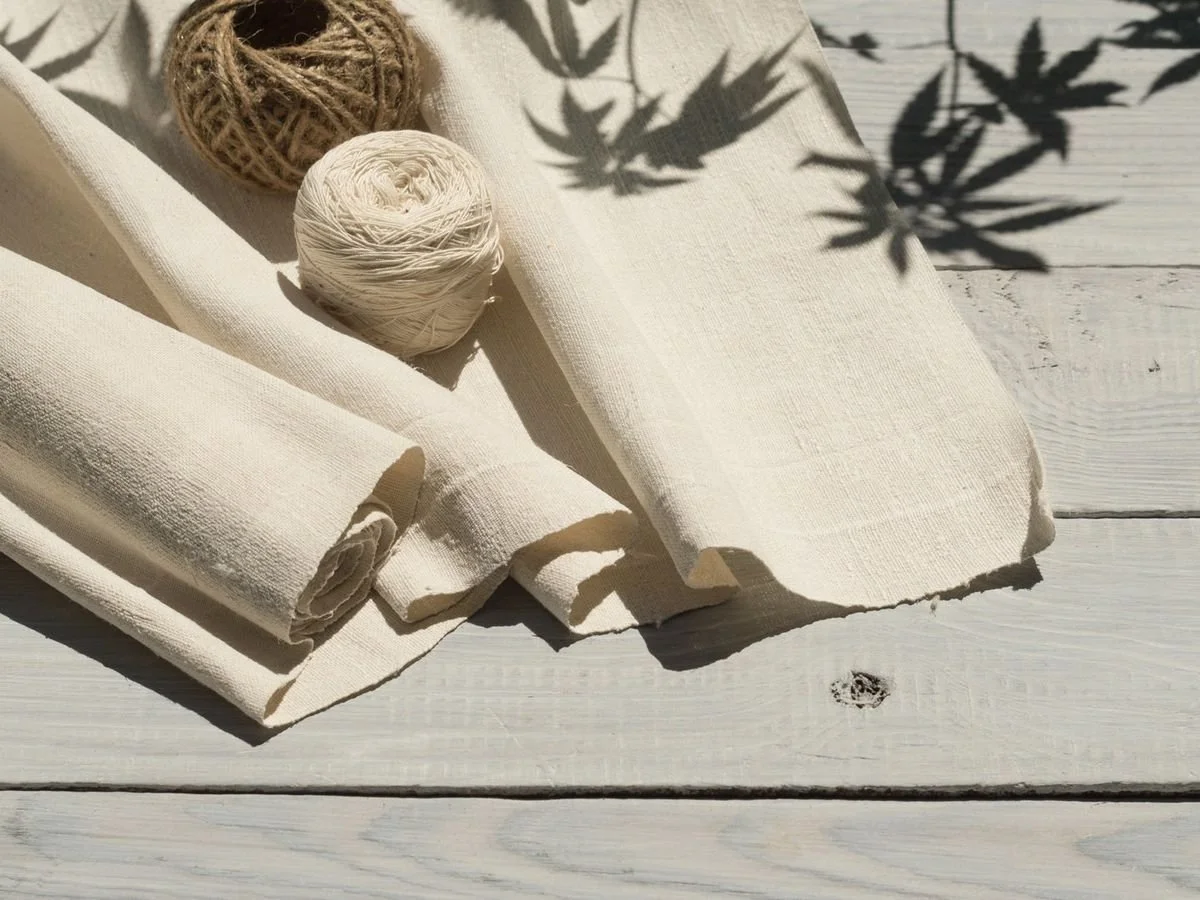
Working in sustainable fashion has changed the way I look at clothing — but more than that, it has changed the way I think about value.
Before working with 100% natural materials, I carried many of the same assumptions most people do: that a good garment should stretch easily, recover perfectly, resist wrinkling, hold its shape indefinitely, and ask very little of the wearer. We’ve been taught to associate convenience with quality.
And yet, much of that convenience has been engineered through synthetic fibers and chemical treatments that disconnect us from the very idea of clothing as something living, aging, and evolving.
Working closely with natural materials has forced me to unlearn a lot.
Falling in Love With Imperfect Materials
I remember early on feeling frustrated by the very things I now deeply respect.
A woven organic cotton would soften and relax with wear, but it wouldn’t “bounce back” the way a fabric blended with elastane would. A linen piece would crease. A wool knit might stretch slightly at the elbows over time. There were moments where these felt like flaws I needed to solve.
I kept asking: How do we make natural materials behave more like synthetic ones?
Eventually, I started asking a better question:
What if they’re not supposed to?
That shift changed everything.
Natural fibers have memory, but not always the kind we’ve come to expect. They respond to the body, to humidity, to washing, to time. They move. They settle. They soften. They age.
In a way, they behave more like skin than plastic.
The Difficulty No One Talks About
I think one of the hardest parts of advocating for 100% natural materials is being honest about their limits.
Yes — there is often less stretch.
Yes — recovery can be lower.
Yes — designing around those realities can be difficult.
And in a market trained by performance fabrics, that can feel like swimming upstream.
I’ve wrestled with that tension often.
There have been moments in fittings where I thought, If we added just 2% elastane, this would be easier.
And sometimes “easier” is seductive.
But I’ve learned difficulty can sharpen creativity.
When you remove stretch, you become more intentional about pattern cutting.
You think harder about ease.
You refine fit rather than outsourcing comfort to fiber blends.
You choose construction details that support longevity.
You design with the body instead of trying to control it.
That has been one of the biggest lessons of my career.
Constraints, when respected, can become a design language.
Relearning Value
Another challenge is price.
Natural materials often cost more — especially when sourced responsibly and made well.
People ask, understandably, why they should pay more for something that may wrinkle, soften, or require care.
I’ve asked myself that too.
And I keep returning to this:
We’ve confused durability with indestructibility.
A polyester garment may survive years physically, but does that make it lasting?
To me, longevity is not about resisting all change.
It’s about remaining useful, beautiful, and beloved over time.
A well-made linen shirt that softens over ten summers.
A wool sweater repaired at the cuff.
Cotton denim that molds to your body.
These things do not remain static — they deepen.
That, to me, is longevity.
Learning to Design for Care, Not Control
One personal resolution I’ve come to is this:
Stop trying to force natural materials to mimic synthetic expectations.
Instead, design — and communicate — around their strengths.
Breathability.
Biodegradability.
Comfort against skin.
Repairability.
Patina.
Character.
And yes, educate around care.
Sometimes overcoming the “limitations” of natural materials is less about changing the material and more about changing the expectation.
That has been surprisingly liberating.
What I Believe Now
I believe natural materials are not perfect.
But I no longer think perfection is the goal.
I believe they ask something of us — more thought, more care, more patience.
And I believe that asking is part of their value.
In many ways, working with these materials has mirrored a larger personal lesson:
The things that endure are often not the things engineered to perform flawlessly.
They are the things made honestly, cared for well, and allowed to evolve.
That is true of garments.
And, I’m learning, true of people too.